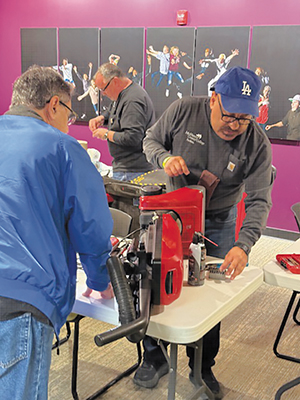
In an age dominated by convenience and consumerism, repair cafés offer a refreshing alternative—spaces where broken items are mended, skills are shared and communities come together. Across northern Illinois, these volunteer-driven events are quietly transforming how people think about waste, sustainability and self-reliance.
Understanding Repair Cafés
Originating in Amsterdam in 2009, the repair café movement was founded as a response to the growing culture of disposability. The vision was to create a space where people could bring broken items and receive help from skilled volunteers to fix them. Today, there are thousands of repair cafés worldwide, including a growing number in Illinois.
Participants bring items ranging from household appliances and electronics to clothing and jewelry. Volunteers—often retired professionals or hobbyists—offer their expertise to diagnose and repair these items. The goal isn’t just to fix things; it’s to teach others to do it themselves.
Northern Illinois Repair Café Highlights
• Evanston Repair Café is co-hosted by Climate Action Evanston and the Evanston Public Li ary. Events are held twice monthly at the Robert Crown Community Center Li ary. Volunteers help repair bikes, electronics, clothing and more.
• Oak Park Repair Café meets on the first Saturday of each month at Fox Park. Volunteers repair small appliances, clothing and other household items.
• Chicago’s Repair Café, located at Sulzer Regional Li ary, in Lincoln Square, has been operating for more than a decade. The café, hosted by Forward Chicago, runs on the second Saturday of each month. Volunteers tackle a wide range of repairs—from rewiring toys and restitching stuffed animals to fixing jewelry and clothing. The café operates on a donation-based model.
• Township of Lyons Repair Café, in Countryside, hosts monthly events at the township building. Attendees can bring items like toasters, torn clothing, lamps and small engines. The café also offers blade sharpening services.
Events are free and open to the public.
The Impact on Communities
Repair cafés are more than just fix-it events—they’re catalysts for change. In Evanston, organizers estimate an 80 percent success rate in repairs, meaning most items brought in are saved from the landfill. This not only reduces waste, but saves residents money and preserves cherished belongings.
Beyond environmental benefits, repair cafés foster intergenerational learning and community resilience. Retired mechanics, seamstresses and tinkerers share their knowledge with younger generations, reviving lost skills and building connections.
The emotional impact is also profound. Lenore Kimmel, a jewelry repair volunteer in Chicago, recalls fixing a cross necklace blessed by the Pope for a woman that was moved to tears. “She was just so overjoyed,” Kimmel says. “It was just amazing.”
A Movement With Momentum
The rise of repair cafés aligns with broader sustainability efforts, including the right-to-repair movement. As states consider legislation to make repair parts and manuals more accessible, grassroots initiatives like these are already making a difference.
In northern Illinois, the momentum is growing. More towns and organizations are exploring the model, inspired by the success of existing cafés.
McHenry County College (MCC), in Crystal Lake, hosted its first Repair Fair in the spring and plans to host another event during the Green Living Expo from 11 a.m. to 2 p.m. on November 1. The community is invited to bring lamps and light fixtures, small appliances, clothing, bicycles and small engines for repair at no cost. MCC’s Repair Fair follows the same repair café model as those listed above, offering free, community-centered repair services led by volunteers.
“We live in a time where it’s easier and more cost effective to replace a broken item than to repair it,” says Ashley Lange, board member with the Environmental Defenders of McHenry County, who helped coordinate MCC’s Repair Fair. “These events offer such a simple solution that’s right in front of us.”
Ash Klinder, a sustainability intern at Joliet Junior College (JJC) and founder of the Romeoville Repair Café, was also drawn to the movement for its values of empowerment and waste reduction.
“I love that people are able to get their items fixed for free and that it’s something we can actionize to make a difference,” she says.
The Romeoville Repair Café takes place at JJC twice a year, in April and October, offering fixes for electronics, textiles, furniture, jewelry, ceramics and bicycles. This year’s event will be from 10 a.m. to 3 p.m. on October 18 at JJC’s Romeoville campus.

Photo credit Kim Hankins
>
How to Get Involved
Whether participants are skilled fixers or simply bringing in a broken lamp, there’s a place for everyone at a repair café. Most events welcome volunteers and donations, and many offer training for those interested in learning repair skills.
To locate a repair café nearby or to start one in a community, visit RepairCafe.us or RepairCafe.org/en.
Established in 2013, the MCC Sustainability Center builds upon McHenry County College’s longstanding dedication to environmental stewardship and sustainable practices. For more information, email Kim Hankins at [email protected]
SIDEBAR:
McHenry County Repair Fair
11 a.m.–2 p.m., November 1
Give broken items new life with help from volunteers repairing bicycles, small appliances, clocks, fa ics and lamps, plus new services for jewelry, eyeglasses and possibly musical instruments.
The Repair Fair runs in conjunction with the 17th annual Green Living Expo (10 a.m. to 3 p.m.), a cele ation of sustainable living featuring solar and renewable energy exhibits, composting demonstrations, eco-gift shopping, green home solutions and tours of McHenry County College’s student farm and new buildings.
Location: McHenry County College, 8900 U.S. Hwy. 14, Crystal Lake. Volunteer information: [email protected].