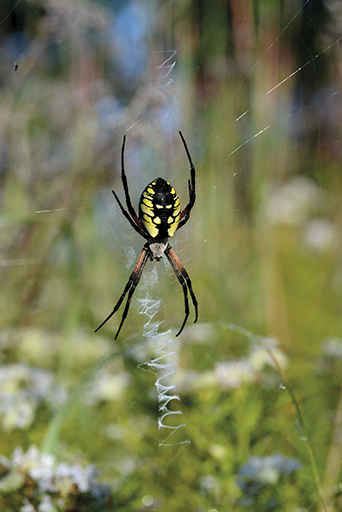
(Argiope aurantia)
On a warm late summer or early fall day, you may see a big, bold, black and yellow spider in a 2-foot-wide circular web in your garden. Known as the black and yellow garden spider, this common, harmless arachnid likes to stretch out its web on a shrub or another tall plant, even flowers. It builds a web to snag its prey, which includes bees, aphids, flies, wasps and grasshoppers. When it feels the web jiggle, it knows it has caught a meal. Garden spiders also serve as food for birds, shrews and lizards. Females lay their eggs in the web at night. They cover the eggs, up to 1,000, in sacs. The female dies, but young spiders remain in the sacs during winter and come out in the spring to begin their lives as adults.
Distribution: southern Canada, United States, Mexico and Central America.
Kingdom: Animalia
Division: Arthropoda
Class: Arachnida
Order: Araneae
Family: Araneidae
Facts:
• The female garden spider is 1.5 inches long, nearly twice the size of the male, and she builds a larger web.
• Each night, the garden spider eats the center of the web, then rebuilds it with silk in the morning.